Posted by: pastorapbell | October 19, 2012

as our promises received cause us to altar our sacrifices!

Abram made an altar when God made a promise to Him. Throughout his lifetime Abram and then later on as Abraham heard the voice of the Lord and did exactly what God instructed him to do. We can classify our Old Testament antecedents as people of faith because they heard, listened to and followed God’s instruction. Noah heard God tell him to construct a gigantic boat in the middle of nowhere to save his generation from impending danger to come. He heard, listened and followed God’s instructions and although his promise took 120 years to materialise, he and his family ‘were saved’, which condemned all those who jeered him, laughed at him and called him all the names under the sun to death. When God’s promises were realised Noah build an altar and offered up sacrifices to God.

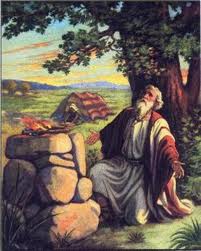
The altar they built was typically made of stone, which was natural and not worked on at all by human hands. It had to be flat so that they could lay the sacrifice on it and carry out the slaughter.

In Genesis 22 God instructed Abraham (notice the name change here) to take his only son and offer him up as a sacrifice. This was the precursor to the offering up of Jesus Christ, God’s only son as the one time sacrifice for all of humanity. Abraham’s only legitimate son Isaac was spared, but God’s only son, Jesus, was sacrificed for us. By building an altar you are indicating that you are about to make a sacrifice. By making a sacrifice, you are indicating that you are giving up something precious. By giving up something precious, you are putting your wants and needs on the back burner for the greater good. The nature of sacrificial offerings is giving up something that is precious to you. And the altar is the place where you offer up this sacrifice. The motif of sacrifice, offering, promises is a recurring theme throughout human history. So what promises have you received and what offering are you going to place on the sacrificial altar today?

Read Genesis 22.
Posted by: pastorapbell | October 9, 2012

as we build our altar to the most high

When God called Abram (Gen 12), he heard the call and followed him immediately. There was no ‘let me get my house in order’ or let me throw a party and say goodbye to my close friends. He left his father’s house with all their cultural practices and went after the invisible God. This is the kind of faith that God (Yahweh) responds to, people who listen to his still small voice, hear clearly what is being said and then act. Abram was a mature man when he was called by God and was given promises that seem to take an age to ‘come to pass’. However, as soon as he came to the first landmark after following the Spirit of the Lord, he was reminded of the promises from God [I will bless you and give the land of the Canaanites to your offspring, v.7] and we are told that he built an altar to the Lord (Gen 12:8). I would suggest that as he travelled by stages towards the south, at every landmark where he heard from God he would build an altar.

Today I want to ask the question, when was the last time you heard the voice of the Lord? And when or where did you build your altar?

For Abram and his descendants an altar was a place where they sacrificed animals, turtledoves and so on. It was a place of death. Where life was taken and blood was shed to preserve their own lives. Today, we can build an altar. On this altar, there is no need to offer up animals or birds, but one where we offer up sacrifices of praise and thanksgiving. Therefore, it could be at the side of your bed or in your office. Offer up praises that we are saved and thanksgiving for all the marvellous things that God has promised us.

So today, go on, build your altar.  Read Genesis 12.1-9.


Posted by: pastorapbell | September 26, 2012

as we maintain our new status at the foot of the cross!

Every process needs to be revisited if it is not then complacency can set in. Complacency is an enemy that slowly creeps in and thwarts the good plans you had. A new creation quickly becomes an old creation when the reasons for being a new creation are forgotten. Good habits are soon forgotten if they are not repeated on a daily basis. To maintain is to revisit and repeat often. Therefore, forgiveness, repentance and renewal of the mind become a lifestyle, not a one off occurrence. Similarly submitting to the will of God and walking in humility ensures that you are walking in the Spirit. That is the path of the Spirit, the path of righteousness and not doing things for selfish reasons. One of the things that defeat many Christians is their ability to forget. Many of us forget that we were once shameful sinners, doing things and going places that we subsequently became ashamed of. We forget that if it was not for the grace of God, we could be maimed, behind bars or worst still in the earth somewhere.  Every one of us needs continuous personal development (CPD), this process starts by taking us back to the cross on a daily basis. The apostle Paul reminds us that living for Christ means dying to self. So, as a new creation, for me to live means dying to complacency and developing my spirit on a daily basis.  Read Philippians 1.

Now restitution is the recovery of everything that was stolen or lost to the original owner. Wow, how would you like to receive everything that was every stolen from you back? For many of us this is quite a daunting proposition. The processes that we have gone through, the relationships that have failed, the things that were stolen from us, have left an indelible mark on us. So, even though we are restored the scars are there for all to see.

Although this may be the case in the natural, there is a different outcome in the spiritual. When God instituted the process of total restoration, he did it in such a way to enable us to go through the processes but come out the other end just as if we had never gone through it in the first place. This is the process that theologians call justification. We who were dead in our trespasses and sins, who were following the course of this world, living as disobedient children, have been elevated to a place far above where we once lived. It is from this vantage point that we can now look back and recognise how broken we were. It is from here that we can join with John Newton and sing, ‘amazing grace how sweet the sound that saved a wretch like me’ and give thanks to God for finding us. It is from the place where we can effortlessly fall on our faces like the angels and cry Holy, Holy Holy to the Lord God almighty who was and is and is to come’ since the whole earth will be full of his glory.  The process [humbleness of heart, baptism in Holy Spirit, submitting to the will of God, listening to the Holy Spirit, being conscientised, renewal of the mind, forgiveness, repentance, deliverance, healing, restoration and restitution] is complete and I am now a new creation, created in Christ Jesus for the sole purpose of bringing glory to God in all that I do. And so I can now stand tall and say like the apostle Paul “it is not I that live, but Christ that lives in me” and therefore the issues that plagued me when I was lost, and kept me ignorant when I lived as a disobedient child have all been thrown into the sea of forgiveness and remembered no more. From now on, I will stay in that heavenly realm and live to praise and thank my Lord and my God, Jesus! Text to meditate on: Revelation 4:6-11; Isaiah 6:1-3 and Ephesians 2:1-10.

Now restoration is the careful skill of bring back something to its original glory. Can you imagine the patience, skill and fortitude required to restore an ancient piece of artwork? Or, on the other hand, the skill required to remove the rust and debris from a piece of precious material without damaging the material itself. This is the sort of delicacy required to bring restoration to an inanimate object. Imagine the patience, skill, endurance, attention to detail and resilience require when restoring the human spirit?

For restoration to occur in us we must go through the pain that removing the outer superficial layer will incur. This can be as quick or take as long as is necessary to effect complete deliverance, healing and then restoration. We are delicate beings and when particularly a loved one in our early stages of development has crushed our spirits, it is like a lorry driving over a tender rose petal. To bring restoration to the rose, the restorer must be gentle, pay great attention to detail and be prepared to take as long as is necessary. Today, if you have been crushed, or have been damaged in any way, allow the precious Holy Spirit to gently caress, heal and start the restoration process in you. The end is in sight, keep holding on! Read Psalm 51.

These imaginary rungs of the ladder towards total wholeness all work in conjunction with each other. Healing is part of deliverance, although different, and deliverance is always preceded by repentance. All these steps have a knock on effect. By going through the process, the individual grows and matures. The whole process of being in Christ is to grow so that we become fruitful. In fact, we are commanded from the very beginning of the creation narrative to be fruitful and to multiply (Gen 1:28). The limiting factor, which inhibits growth and fruitfulness, is the propensity for us to disobey and to do things our own way. Again the Lord reminds us in scripture that ‘His ways and not our ways neither are His thoughts our thoughts (Isaiah 55:8). And so the process of healing is ‘putting the missing ingredient back into a situation’. For a cancer patient, healing is replacing the damaged cells with good fully functional ones. For someone with a broken bone, it is supporting the limb until the structure has reconstructed itself. And for a broken spirit, healing is the process of reconnecting that spirit back to the creator of spirits, Yahweh. Now there are many gods in our world today, but it is Yahweh, the God of the bible, the only wise God, who is the creator that heals a broken spirit. Putting back the missing ingredient to body, soul (mind) and spirit was the mandate that Jesus set out with (see Luke 4:18ff), likewise we who follow Jesus are called to be ambassadors of this process as we ourselves are delivered, healed and restored.  Read Luke 4&5 to see the great task that lies ahead of us.

Posted by: pastorapbell | September 4, 2012

as we look at the nature of deliverance (part 9)

For some, deliverance is an ambiguous word as it conjures up many different images in the mind. One of the synonyms of deliverance is liberation. Liberation is to be set free. This is a true definition of what liberation is. When Jesus started his ministry at the age of 30 he initiated it by reading from the book of Isaiah 61:1-2a. This was his manifesto and the blueprint of what he would aim to accomplish during the next 3 ½ years of ministry. Not only was Jesus’ mission to usher in the kingdom of God, it was also to initiate a spirit of deliverance, that would set all those who were captives free. To be delivered then, is to be set free. The question that we must all ask is, what am I being delivered or set free from? Furthermore, what happens to me after I am set free?

During Jesus’ ministry, his first and most important task was to set people free from a slavery mindset. People who are controlled by a spirit jealousy and envy exhibit this mindset. Although at the time of Jesus the people of Israel had been set free from slavery for well over 400 years, they were still under the rule of the Roman Emperor. They were free to worship the God of their choice, but they yearned for self-government and their own land. This preoccupation with physical liberation only pushed them further into ascetism and religious bigotry. Jesus set about his deliverance ministry by using word pictures to present the working of his kingdom to his hearers. As people received his message and implemented it, they saw miracles, signs and wonders. As the kingdom of God spread, it was left to the apostle Paul to crystallize how we receive and maintain our deliverance. This is his methodology as outlined in Romans 12.  We must be transformed [ delivered] by the renewing of our minds. For an individual to be transformed, that is, change the way they think, live and operate, their minds must first be renewed. They must be delivered from the old and rigid ways of thinking and acting.

We must bear in mind that each rung on the ladder is receded by the previous one, and if we skip one step, we will be delivered but there will be a gap in our lives as the process has not been completed fully. Hence, we still have many people in leadership who have the wrong motives and therefore have the wrong expectations.

After our initial act of faith in accepting Jesus as our Lord and saviour, we may think that there is no further need for repentance. However, due to our nature and the propensity to make mistakes, there is a constant need for repentance. Simply put, repentance means to turn away from. That is, we stop doing an action or an activity that is leading us away from God. It is by continued repentance that we come to understand the true nature of God. In his letter to the Ephesians brethren, the apostle Paul wrote this: “But because of his great love for us, God, who is rich in mercy, made us alive with Christ even when we were dead in transgressions—it is by grace you have been saved” 2:4-6. Even when we were very far from God, he was making provision for us, so that when we came home [repented and turned around] he would lavish his great love on us. If our great God can demonstrate a repentant heart, then so should we. Therefore, we are able to sing to him: ‘thank you oh my father for giving us your son and leaving your Spirit till the work on earth is done’. So today, develop a repentant spirit and keep repenting so that grace may abound in your hearts. Read Ephesians 2:1-22.

The ability to forgive is one that is part and parcel of the Christian way of life.  However, many Christians fail to implement this very necessary principle so that they can in turn receive forgiveness. Why should I forgive and what are the precedents that suggest that I should forgive?  Firstly, forgiveness is at the heartbeat of God. When humanity disobeyed God and followed the serpent, he could have abandoned his creation and left them to their own devices. However, He implemented a plan for their total restoration. This plan involved the sacrifice of his only son and forgiving humanity for turning their back on God and enabling everyone who put their trust in Jesus to receive total forgiveness. Secondly, by developing a heart of forgiveness, each believer removes from their spirit the propensity to plant a root of bitterness in their heart. The writer of Hebrews exhorts us thus: “See to it that no one fails to obtain the grace of God; that no root of bitterness springs up and causes trouble, and through it many become defiled.” (Hebrews 12:15 NRSV). If we fail to forgive and harbour unforgiveness in our hearts, we are laying up trouble for ourselves in the future. This trouble comes in the form of bitterness in our spirit. This bitterness manifests itself as physical disease. There are many Christians whose lives ‘are cut’ short by ailments such as liver disease because they have harboured bitterness in their heart.

Jesus is our model for forgiveness. When Judas betrayed him, instead of giving him the cold shoulder and ostracising him, he embraced him and invited him to partake of the last supper with him. When Peter denied him, his first action after his resurrection was to restore Peter rather than berate him and leaving him out in the cold.  Furthermore, when Jesus was on the cross in agony, instead of berating those who had crucified him, he asked father God to forgive them since they had no idea that they were fulfilling the plan originated by God to bring restoration to humanity. If you are unable to forgive, it is likely that you will not receive forgiveness. Read Matthew 6:9-15.

The apostle Paul encourages every believer that once they accept Jesus as their saviour and king they must go through the process of transformation so that they can become like Jesus. This transformation will never occur until the mind of the individual is renewed. He write that; “we must be transformed by the renewing of our minds (Romans 12:2).” The question we must ask ourselves is how do we renew our minds, and how does the transformation occur?

Firstly, let me say that our minds are the battleground of our spiritual warfare. And we are in a battle when we put our faith and hope in Jesus Christ. Again we are told by the apostle Paul that we do not wage war against flesh and blood, viz; “For the weapons of our warfare are not physical [weapons of flesh and blood], but they are mighty before God for the overthrow and destruction of strongholds,  [Inasmuch as we] refute arguments and theories and reasonings and every proud and lofty thing that sets itself up against the [true] knowledge of God; and we lead every thought and purpose away captive into the obedience of Christ (the Messiah, the Anointed One), Being in readiness to punish every [insubordinate for his] disobedience, when your own submission and obedience [as a church] are fully secured and complete”, (2Cor 10:4-6 Amplified). Once we know where our battleground is, it is up to us to know how to fight our enemies and how to renew our minds.

Secondly, we must know how to fight. The renewal of the mind dictates that we allow the Lord to fight our battles whilst we fight the good fight of faith by being in Christ Jesus. We renew our minds by reading copiously the word of God. The psalmist says ‘the entrance of your word brings light, it impart understanding to the simple’, Psalm 119:130. Light comes when we gain understanding from the word that we read. This in turn enables us to act in a way that brings glory to God and transformation to our character. Our way of thinking changes, our habits are upgrades and our character [who we are] is being transformed to be more like Jesus. And so wholeness becomes more and more viable!

« Newer Posts - Older Posts »

Categories