Posted by: pastorapbell | April 12, 2013

as we put all our hope and trust in God!

Hope deferred makes the heart sick, but a longing fulfilled is a tree of life (Proverbs. 13:12 NIV). Hope is defined as ‘a feeling of expectation and a desire hopefor a particular thing to happen’ (Oxford online dictionary). Hope is an expectation of something; it is closely related to and tied with faith, which is; ‘the complete trust or belief in something or someone’. It follows then, that faith and hope are not only closely related they must work together. The writer of Hebrews tells us that without faith it is impossible to please God (Heb. 11:6). And that those who come to God must trust and believe explicitly in him. As we saw from the Joseph story, Joseph trusted God and hoped for better day. For Joseph, the process was a long and arduous one, which took about twenty years to complete. His heart must have been sick as he went from being the favourite of twelve sons, to being sold as a slave and left in a God forsaken prison accused of raping his employers wife. This did not deter his faith in God though and after two years of living in that desperate gaol, his opportunity came and his gift brought him before the most powerful man on the earth at the time, Pharaoh the king of Egypt.

What would have happen if he had lost hope and gave in to the pride of life and the lust of the eyes that the world craves for? What would have happened to God’s people if Joseph had succumbed to the advances of Mrs Potipher and went into her bed?

Moses declared that it is better to be ill-treated with the people of God than to enjoy the pleasures of sin for a season (Heb. 11:25).

Since hope deferred makes the heart sick, today make your heart glad by hoping and trusting in a God who fulfils his promises. Read Psalm 42:5.

Posted by: pastorapbell | April 8, 2013

as we develop the virtue of waiting for the change to come!

The recent inclement weather has given us an insight into one of the virtues we need to extol. Here we are waiting for spring to manifest itself, and all we Hope waiting for a better dayget is more of the same, cold, damp and generally unpleasant weather. When will it end, when will spring finally arrive? Scripture reminds us, that it is during these times of waiting that our character is honed and developed. The ability to wait and not to succumb to taking shortcuts is a virtue that will yield myriad benefits in the future. The Joseph story of the bible reminds us that God has a plan for our lives and that this plan will not be executed until we have had all the rough edges knocked off us; we have been sanded down and are ready to be polished. As a seventeen year old, Joseph had the gift to see into the future, but he lacked the maturity and the wisdom to implement his destiny then. He had to learn to wait on God and it is in that waiting period that his character was developed.

During the years he spent faithfully serving Potipher, he learned to be loyal, forthright and diligent paying attention to detail in running his masters house. He could have circumvented his destiny had he succumbed to the advances of Mrs Potipher, however he chose to honour God which subsequently landed him in prison for two years on the charge of rape. The question we all need to ask now, is ‘how could a person imprisoned for alleged rape, end up becoming the second most powerful man in that country?

Answer, he learned to wait for God. Although the winter season seems to be prolonged, and snow is still falling in April, the ability to know that summer will come, gives us hope. In waiting for God, we may be tempted to take short cuts, but take a leaf out of Joseph’s book and learn to wait until your change comes. Job did and he prospered. Can you? Read his story in Genesis 38.

One of the ravages of the Trans-Atlantic slave trade and the enslavement of Africans as chattel was, the destruction of the family unit and the severing of looking backthe links with the past. Neuroscientists have proven that memory and particularly the ability to recall and reflect on the past, make an individual human. The disconnect from the past dictates that life is lived on a ‘day to day’ hand to mouth basis. This form of existence has massive impact on the individual and on their offsprings. What do I mean by this? The Ten Commandments (Ex. 20:4-6) tells us that, ‘the sins of the fathers will visit the children to the third and fourth generation.’ Therefore, if the father fails to plan for the viability of his children, then the children will also fail to plan and so the cycle will continue ad infinitum.  

Today we have a generation of people, particularly those of Caribbean heritage, who live for the ‘now’ and worry about tomorrow when it comes. In this season of ‘lent’ when people give up certain things and ‘the passion’, when Jesus  suffered, bled and died for fallen humanity, let us reflect ion the fact that long before Jesus came, God had planned it. Long before his cruel death on the cross, God knew about the impact of Easter Sunday. And so, today let us research and remember our past and thereby plan for our future. Read Matt 26:1-30.

In surveying the book of Nehemiah and gleaning the nuggets from it, one thing is blatantly apparent. If we are unaware of where we are presently, we will never be able to get to where we need to be. Nehemiah faced many obstacles in his quest to rebuild the wall of his beloved city and secure its gates.

Who am I?

Who am I?

He faced much opposition, but he knew his roots and his family lineage.

For me today, I see my quest as rebuilding the walls broken down by the debilitating effects of structural racism, institutional classism and continued self-hatred among the dispersed Africans. The rebuilding process must start with the family unit. This unit includes and starts with father and mother. Sadly, many from the African Caribbean diaspora, have never been fathered or were ‘brought’ up by a single mother or a grandmother. The destruction of the family unit was a deliberate ploy by the slaver during the 300 years that the slave trade flourished in the Americas. Listen to what Frederick Douglas, an ex-slave said about slavery and life on the sugar, cotton and coffee plantations in the Americas, in 1855.

Slavery does away with fathers, as it does away with families. Slavery has no use for either fathers or families, and its laws do not recognise their existence in the social arrangements of the plantations.” (Frederick Douglas, My bondage My Freedom, 1855).

How do we start the rebuilding process? By being in Christ first, then by being delivered by having our minds renewed. In Christ, there is neither Jews nor Greek, slave or free, male or female (Galatians 3:28ff), but in Britain, there is still structural evil to fight and reparations to be made to the descendants of enslaved Africans. See ! http://www.independent.co.uk/news/uk/home-news/britains-colonial-shame-slaveowners-given-huge-payouts-after-abolition-8508358.html

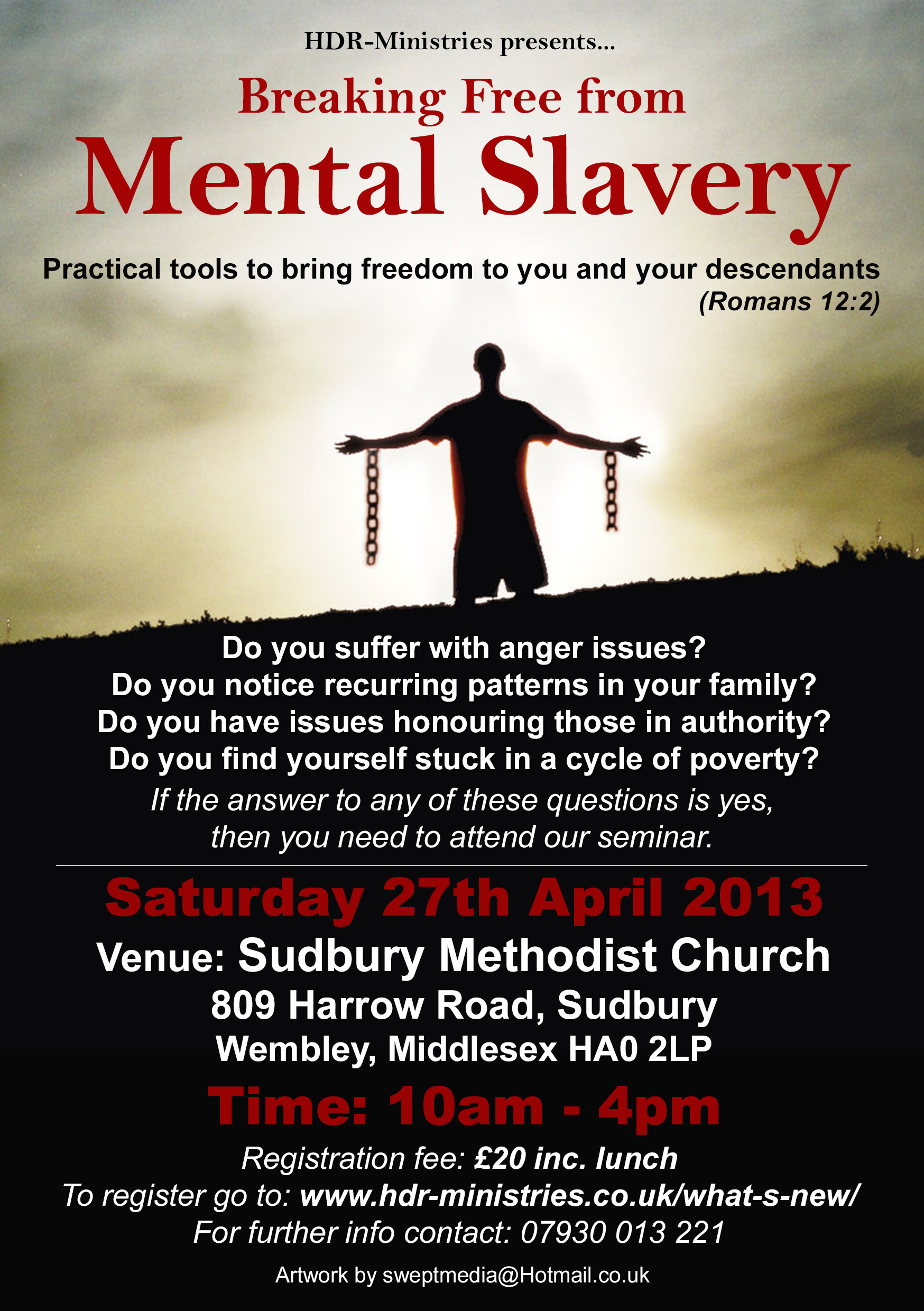
You must attend this seminar to break the chains and start the rebuilding process.

HDR Final Draft 2 (Feb 13 red)


Before Jesus started his public ministry, he opened the scripture in his local synagogue and read from the book of the prophet Isaiah. This is what he oak of righteousnessdeclared: ‘The spirit of the Lord is upon me, because he has anointed me to bring good news to the poor. He has sent me to proclaim release to the captives and recovery of sight to the blind, to let the oppressed go free, to proclaim the year of the Lord’s favour’ (Luke 4:18ff). These words are pregnant with possibilities. The declaration clearly states that it is the ‘spirit of the Lord’ that empowers the individual to act. This was Jesus’ manifesto, which clearly details what he would be doing at this point in his ministry.

His first task is to bring ‘good news to the poor’. The good news we will later learn from the apostle Paul, is the power of God to salvation to everyone who believes, (Rom 1:17). This is the gospel. His next agenda item is to proclaim release to those who are in captivity. Sadly, many people go into captivity because of their inability to listen and follow what God has instructed them to do. Although the gospel touches the spirit of an individual, if their minds are not renewed, they will act and behave in the same manner as they did before becoming a believer.

This is where many from the African Caribbean Diaspora are currently located. They have heard the good news, accepted Jesus as their Lord, but have not had their minds renewed. Therefore, many still get involved in practices, which are alien to the teachings of Jesus. In effect, they are still captive to certain practices, and fail to enjoy the Lord’s favour. Although many have heard the good news, they are still be bound and remain blind. Read Nehemiah 8.

Posted by: pastorapbell | February 13, 2013

as we retreat to advance

One of the problems that plague us is the need to belong. For many of us from the African  Diaspora, this was made doubly difficult by the systematic identitydestruction of our heritage once our ancestors arrived in the west in the 16th and 17th centuries. The issue of identity and of who we really are is one that scholars have long debated and have come to different conclusions.

Some say that we have retained a significant amount from our ancestors through a sort of osmosis, that is, some things are so ingrained in our psyche, that it is very difficult to remove. Others say that we are now a new hybrid human with a Euro-centric worldview.

Nevertheless, who do you saw you are? If you are from the Caribbean, you identify yourself from that particular island. If you are from a state or a country in the Americas, you identify yourself with that state or country. Therefore, how far back can you go? And who are you really?

The vast majority of those of us, who accept the Lordship of Jesus Christ, find a new identity in him. However, we cannot deny the fact that we have a heritage rooted in history. Our heritage in Christ gives us freedom, spiritually and emotionally, however, our cultural heritage has bound many of us. Therefore, there are still Christians who are devout, dedicated and committed to their fellowship, but still practice, Obeah, Santeria, Juju and other forms of witchcraft. There are those who burn black candles when they want to snuff out their enemies, and still others who tie ‘red cloths’ on their door handles or hang tape measures over their door frames to ward off evil spirits or departed ones who may come back to trouble or visit them.

Everyone  need to know their ancestry. Like a large section of the exiles who returned to Jerusalem during the time of Nehemiah and Ezra (see Nehemiah 7:61ff), they could not prove who they belonged to and so were excluded from the religious celebrations. Today a vast swathe of those in the Diaspora and particularly our boys, do not have a clue about their ancestry and buy into the media images that ‘white is good, black is bad’. They effectively live on the edge of society surviving by any means necessary and are excluded from the benefits that this country offers. They despise their own people and reject who they are. Others become so Afro-centric, joining movements like the Ausar Asset, that they deny the liberation that being in Christ brings. Therefore, my brothers and sisters, start the process of finding out your true spiritual and your historical identity. Read Nehemiah 7:61-73.

Once Nehemiah decided to build the wall of Jerusalem and repair its gates, the opposition surfaced. Now the opposition came from three sources that oppositionformed what I call the ‘diabolical trinity’. Their intention was keep the people of God in a state of perpetual disgrace. One of the three, Tobiah, was a descendant of the Moabites, from Lot’s incestuous relationship with his daughters. On the surface, he was a good man. In fact, his name means God is good. However, by aligning himself with Sanballat he was undermining the work that Nehemiah was doing. And Geshem the Arab, whose name means rain, was there to dampen the work of the Lord.

Once you decide to do something, be prepared for opposition even from people who are close to you. The opposition will mock what you are doing and ridicule you. Listen to what Sanballat said to Nehemiah and his colleagues when they started the building project. ‘What are these feeble Jews doing? Will they restore things? Will they sacrifice? Will they finish it is a day? Will they revive the burnt stones out of the heaps of rubbish? Moreover, Tobiah quipped, ‘Even if a fox were to go on the wall it would break up’ (4:1-3).

The opposition is there to discourage us, get into our mindset and cause us to abandon our God given call. The people of God wanted to break free from the shackle of slavery, the opponents wanted to keep them fighting each other. Today the choice is yours, are you part of the building project or part of the mockers?

Read Nehemiah chapter 3.

Nehemiah had a plan to rebuild the wall so that his beloved city, Jerusalem could be a safe place to worship and live. After seeking God for four months his Trustprayers were answered when the king sent him to do the work and gave him all the provisions and protection he needed. However, on arrival in Jerusalem he kept his plans close to his chest and only revealed them to a few of his trusted aides. He knew from experience that if God put something in your heart to do then there will always be opposition. After inspecting the wall by night and assessing what materials would be required, Nehemiah presented his plans to the inhabitants, his fellow Jews, who received the project with enthusiasm, (2:18). It was not long before the opposition heard about the plan. As soon as they heard, they started to plot to thwart it. The opposition came in the form of three men. The governor of Samaria, Sanballat the Horonite, Tobiah the Ammonite and Gershom the Arab. Now Sanballat had previously been implicated in a plot against the king of Persia, so he was no stranger to rebellion. His name means ‘the moon god is god’. They constituted the diabolical trinity who wanted to see the city of God remain a disgrace.  As the local officials, they had authority to authorise or stop any work in the city. However, when Nehemiah showed them the letter from the king with his seal on it, they could not stop him from proceeding. This did not stop them from using other methods to stop the work.

Today, be clear that, when God puts something in your heart to do that will bring his grace to a group of people, the enemy will always raise up those he controls in opposition to it. Nevertheless, remember what the Psalmist tells us in Psalm 37:1-3, do not fret because of the wicked, do not be envious of wrongdoers, for they will soon fade like the grass and wither like the green herb. Trust in the Lord and do good so will you live in the land and enjoy security. The plans and the purposes of God will prevail.  Read Nehemiah 2:11-20.

Posted by: pastorapbell | January 11, 2013

should Christians fast and pray in the twenty-first century?

Long before Jesus told his followers that certain diseases are so ingrained and embedded in the psyche of certain individuals and in the generational Prayer and fastinglineage of others, that it is almost impossible to erase except by prayer and fasting (Mark 9:29), Nehemiah and his Jewish colleague knew the benefits of prayer and fasting and petitioning God. Therefore, after Nehemiah had fasted and prayed for 120 days, there was a difference in his appearance. When any individual changes what they do, there will be a difference in how they look and feel. Also, when anyone spends time in the presence of the king of Glory, their appearance changes, see Moses’ experience in Exodus 34:29.

Because Nehemiah looked differently, the king noticed it and decided to find out what was going on. On noticing the transformation in his appearance, King Artaxerxes really needed to know, since Nehemiah was his cupbearer and was the one responsible for tasting anything before he or the queen ate it. He could collude with an enemy to poison him! However, when the king approached Nehemiah, he saw this as his chance to put his case before him. Nevertheless, before speaking to him, he prayed under his breath and asked God for direction. He them laid out complaint and his pre-arranged plan in detail and on hearing it the king and Queen sanctioned it.

What can we take from this? Firstly, that prayer and fasting changed things.  Secondly, the king of kings sees our hearts and knows our motives. Thirdly, we must have a S.M.A.R.T plan. That is it must be Specific, Nehemiah wanted to rebuild the wall and gates around Jerusalem, v.5. Measurable, the king asked him how long it would take, v.6; Attainable, he asked for materials to do the task; Realistic, the Job was achievable within the timescale he set and finally when he completed the task he would return to serve the king (Time-bound).

Today, ask God for a plan to complete the task that he has called you to do, and read Nehemiah 2:4-10.

After Nehemiah heard the story of what had happened to the beloved city of Jerusalem from his brother Hanani, whose name means grace, something kicked in him. Like many of his fellow Israelites, he knew about the song of ‘praise and prayer for Jerusalem’ written by David over 550 years before him. In it David writes, ‘I was glad when they said to me, “ Let us go to the house of the Lord!” our feet are standing  within your gates, O Jerusalem. Jerusalem built as a city that is bound firmly together. To it the tribes go up, the tribes of the Lord, as was decreed for Israel, to give thanks to the name of the Lord. For there the thrones for Judgement were set up, the thrones of the house of David. Pray for the peace of Jerusalem: “May they prosper who love you. Peace be within your walls, and security within your towers.” For the sake of my relatives and friends I will say, “Peace be within you.” For the sake of the house of the Lord our God, I will seek your good.’  (Psalm 122:1-9 NRSV).

The reality for him and his brother was that the city of God was a disgrace. Its walls were broken down and there was no longer reverence for the name Prayer_motivationalof the Lord there. Nehemiah was in Susa, the capital of Persia (Modern Iran), which is over 1000 miles away from Jerusalem. What could he do? He had no resources, no army, no builder or mason to call on. Initially all he could do was pray and fast. When he heard the news in the month of Chislev, (December in the Gregorian calendar), he began seeking a strategy for his project with fasting. Although it was his dream to rebuild the city of Jerusalem, he had no resources only a plan. And so he prayed and confessed, repented and petitioned God month after month until he got answers to his prayer in Nissan, (April). All he wanted was to get the chance to rebuild the walls of the city of God and restore the entrances so that his people could once again have a dedicated place to revere the name of the Lord.

Today, we need the rebuild the spiritual walls in our country. We need places where we are doing the will of the Lord and revering his name according to his word, the bible. As the established religious organisation in Britain grapple with issues such as the ordination of women and the acceptance of homosexuals into the ministry, spirit led Christians need to have a plan to rebuild the spiritual walls of Britain. Our desire must be that all those who believe in Jesus as Lord, will become Ephesians 5:17&18 people. And as the will of the Lord is done and the spiritual walls are rebuilt, we can put the Great back into our nation. Each one of us has a job to do, so start by rebuilding the spiritual walls in your life, one brick at a time.

Read Nehemiah 2:1-3.

« Newer Posts - Older Posts »

Categories