Introduction
Black Majority Churches have played an extraordinary role in the spiritual, cultural and social lives of African and Caribbean communities, particularly within Britain and the wider diaspora. They have provided spaces of belonging in societies marked by racism, migration, displacement and exclusion. They have nurtured faith, developed leaders, supported families and created communities in which Black identity and Christian spirituality can coexist with dignity. Yet precisely because these churches have historically challenged marginalisation, an uncomfortable question must be asked: to what extent have some Black Majority Church leaders reproduced the hierarchical models of Christianity inherited from colonialism?
This question is not an accusation against Black churches as a whole, nor does it suggest that order, ceremony or leadership titles are inherently paganistic. The issue is more subtle. Colonial Christianity frequently associated spiritual authority with social rank, institutional office, elaborate titles, clerical dress, proximity to powerful people and obedience to leaders positioned above ordinary believers. Christianity has consequently become entangled with systems of class and imperial authority. The danger arises when churches formed by communities once subjected to these systems reproduce similar assumptions about power.
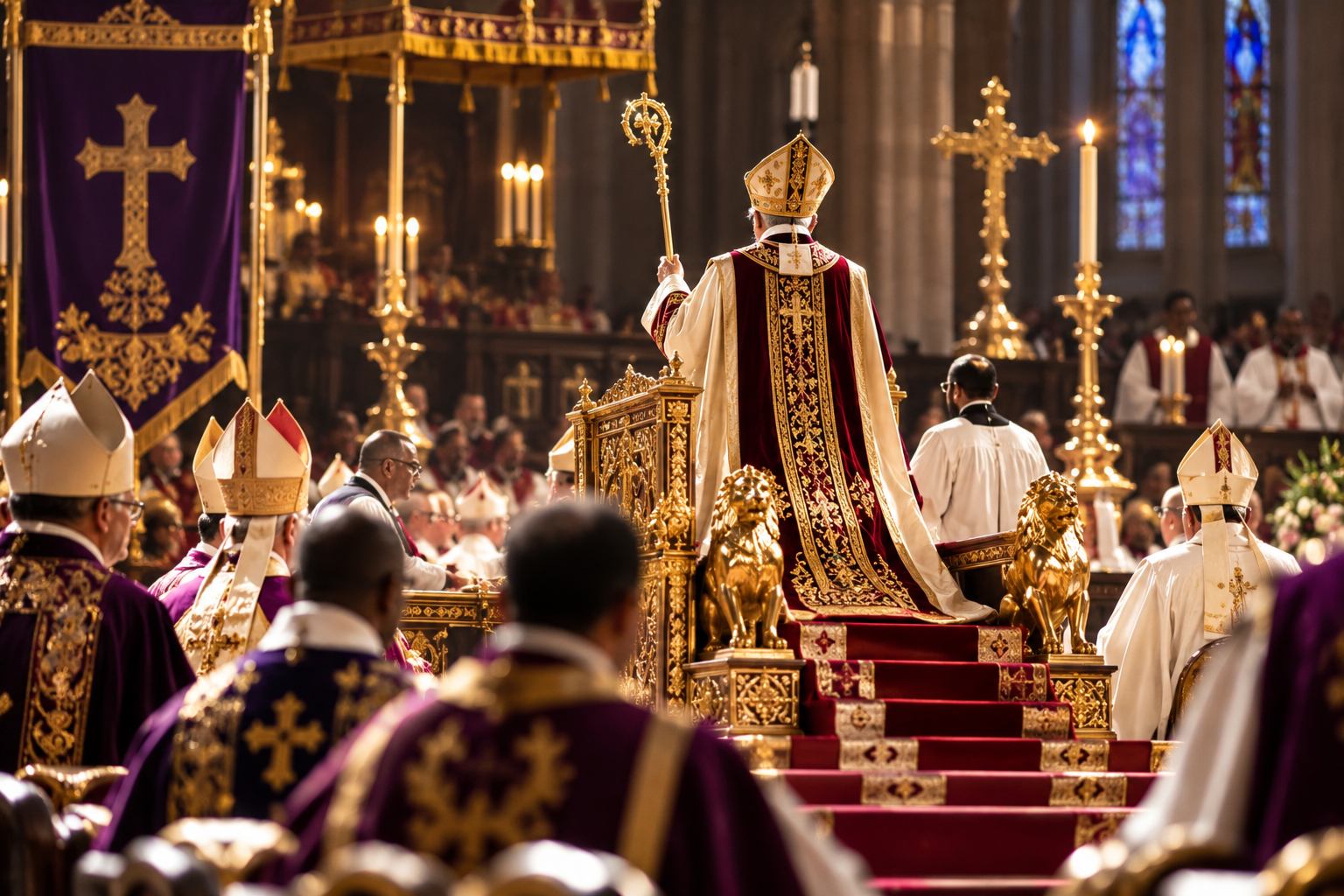
The resulting culture might be summarised through three words: prestige, performance and pomp. Prestige concerns the pursuit of status; performance concerns the construction of an impressive ministerial persona; and pomp concerns the visible symbols through which religious importance is displayed. Against these stands another model of Christian leadership: service. The central argument of this essay is that Black Majority Churches fulfil their liberating potential most clearly when leadership is understood not as elevation above the community but as responsibility within it.
The Colonial Inheritance of Christian Hierarchy
Christianity existed in Africa long before modern European colonialism. Ancient Christian communities in Egypt, Ethiopia and North Africa make it historically inaccurate to describe Christianity simply as a European religion exported to Africa. Nevertheless, European colonial expansion profoundly shaped many forms of Christianity subsequently established across Africa and the Caribbean.
Missionary Christianity was often organised through hierarchical institutions. Authority moved downwards: from denominational headquarters to bishops, missionaries, clergy and finally congregations. European missionaries frequently occupied senior positions while indigenous Christians were expected to demonstrate loyalty, discipline and conformity before receiving equivalent authority. European culture was also confused with Christian maturity. Clothing, education, speech, worship styles and social manners associated with Europeans were sometimes treated as signs of civilisation and spiritual advancement.
Political colonialism formally ended across much of Africa and the Caribbean in the mid twentieth century, but cultural patterns did not disappear when political systems changed. They survived through institutions, expectations and habits. Churches may therefore reject colonial domination while unconsciously retaining colonial ideas about leadership.
This becomes particularly significant when Christian ministry is imagined as social ascent. The pastor is no longer simply a servant entrusted with responsibility but a distinguished figure occupying a superior spiritual class. Titles multiply: Reverend, Apostle, Chief-Apostle, Prophet, Bishop, Archbishop and other honorifics, become markers of prestige rather than descriptions of responsibility. Leaders may receive special seating, ceremonial introductions and highly visible treatment that separates them from ordinary congregants.
Titles themselves are not necessarily problematic. Christian traditions have long used offices and titles to clarify responsibilities. The critical question is what those titles mean within the community. Do they identify responsibilities, or establish rank? Do they encourage accountability, or insulate leaders from questioning?
Prestige: When Calling Becomes Status
Prestige becomes dangerous when ministry is treated as a pathway to social distinction. In communities that have historically experienced racial and economic exclusion, the church has understandably become an important location for Black leadership. People denied recognition in mainstream institutions could become respected pastors, theologians, musicians, organisers and community leaders within the church.
There is something profoundly positive about this. Black churches have created opportunities for leadership where racist societies frequently denied them. Yet the desire for dignity can gradually become a desire for status.
A leader may begin measuring ministerial success through the size of a congregation, the prominence of speaking engagements, the number of followers online, relationships with celebrities or politicians, expensive clothing, impressive buildings or proximity to internationally recognised ministers. Leadership then becomes competitive. The question subtly changes from Whom am I serving? to How important am I perceived to be?
Here the resemblance to colonial hierarchy becomes striking. Colonial systems depended upon visible distinctions between those considered superior and those positioned beneath them. When churches reproduce cultures in which senior leaders expect exceptional treatment, unquestioning obedience or visible demonstrations of deference, they risk baptising hierarchy rather than transforming it.
Jesus presents a radically different understanding of greatness. When his disciples competed for status, he tells them that rulers exercise authority over others, but “it shall not be so among you” (Mark 10:42–43). Greatness within the kingdom is measured through service.
This teaching does not abolish leadership. It redefines it.
Performance: The Construction of the Powerful Leader
A second concern is performance. Contemporary ministry exists within a media environment in which pastors can become public brands. Livestreaming, conferences, podcasts and social media can extend the reach of Christian teaching enormously. Yet these platforms can also encourage leaders to construct carefully managed images of success.
The minister becomes not merely a pastor but a personality.
Charisma can then overshadow character. Congregations may become impressed by preaching ability, clothing, confidence, prophetic vocabulary or the appearance of prosperity while paying less attention to accountability, theological depth and treatment of vulnerable people.
Performance is particularly dangerous when leaders feel compelled always to appear powerful. They cannot admit uncertainty because prophets are expected to know. They cannot acknowledge mistakes because bishops are expected to command. They cannot display vulnerability because successful leaders supposedly demonstrate perpetual victory.
Such leadership ultimately imprisons both congregation and pastor. Members learn to associate spirituality with spectacle, while leaders become trapped inside the personas they have created.
There is also a theological problem. The New Testament repeatedly presents Christian leadership through images of shepherding, stewardship and service. Paul describes Christian ministry through the paradox of divine treasure carried in “jars of clay” (2 Corinthians 4:7). Christian authority therefore does not depend upon pretending that leaders are extraordinary human beings. Its credibility rests partly upon recognising that ministers remain fallible people dependent upon grace.
Pomp: When Symbols Become the Substance
Pomp is the ceremonial expression of prestige. Elaborate vestments, reserved chairs, entourages, processions, protocol teams and formal introductions can communicate honour and continuity. Ceremony is not inherently wrong. African and Caribbean cultures possess rich traditions of honour, dress, celebration and communal recognition that should not casually be dismissed as colonial imitation.
A critical analysis must therefore distinguish cultural expression from hierarchical domination.
The issue is not whether a congregation honour its pastor or bishop, it is whether ceremony communicates service or superiority. It becomes an issue when the bishops, pastors and ‘the clergy’ wears particular clothing to designate their rank and position on the ladder.
Furthermore, it becomes extremely problematic when leaders receive luxury while vulnerable congregants struggle, or when leaders expect treatment, they would never offer others, or when questioning authority is described as rebellion against God, or finally when access to leaders depends upon ‘your’ status within the community, then something deeper has happened. And Religious symbolism has begun reinforcing inequality.
This is especially troubling because Christianity centres upon Christ, whose ministry repeatedly moved towards those without social prestige. Jesus touches people regarded as unclean, eats with the socially rejected and washes his disciples’ feet. The washing of feet in John 13 is particularly significant because Jesus does not surrender authority by serving. Rather, service reveals what his authority means.
Christian leadership, therefore, turns conventional hierarchy upside down. The person with greater responsibility should become more available for service, not more entitled to privilege.
From Colonial Mimicry to Decolonised Leadership
Decolonising church leadership does not mean rejecting everything inherited from European Christianity or replacing European hierarchy with an equally rigid African or African-Caribbean hierarchy. Nor does it mean romanticising pre-colonial cultures, which possessed their own structures of authority and inequality.
Decolonisation requires asking whose interests church structures serve and what understanding of humanity they communicate.
A genuinely decolonised church should resist the assumption that authority makes one person inherently more valuable than another. In a recent sermon, I asked the question, which part of your body is the most important. Some said it was the head whilst others said the heart or the lungs or the liver. When I pointed out that each body part had to work in concert with the other parts and was vital for functioning of the entire body. And as the apostle Paul tells us in 1Corinthain 12, the invisible parts are vital to the functioning of the body, and a mature body will pay greater attention to the parts which seem less important. This picture of a mature fully functioning body reminds us that leadership roles may differ, but human dignity does not. The pastor, cleaner, musician, administrator, elderly member, young person and newcomer belong to the same body.
This requires practical structures, not merely sermons about humility. Financial transparency matters. Independent safeguarding matters. Leaders should be accountable to functioning boards rather than surrounding themselves exclusively with loyal supporters. Congregants should be able to raise concerns without being accused of dishonouring spiritual authority. Succession should be based on discernment and competence rather than family dynasty or personal loyalty. Women and younger leaders should be given meaningful opportunities to contribute rather than simply being mobilised to support established male authority.
Accountability is not an attack upon spiritual leadership. It is one of the ways healthy communities protect both leaders and congregations.
Choosing Service Over Status
The alternative to prestige, performance and pomp is not weak leadership. It is servant leadership.
Service requires leaders to understand authority as stewardship. A pastor has influence because something has been entrusted to them: people, resources, teaching responsibilities and communal confidence. These are not possessions. They are trusts.
Choosing service over status may therefore mean asking difficult questions. Would leaders still pursue ministry if there were no titles attached to it? Would they serve people who could offer them nothing in return? Are churches spending more resources celebrating leaders than developing members? Can pastors be corrected? Are ordinary members becoming mature disciples, or merely loyal audiences? Does leadership create new leaders, or create dependency upon one personality?
The deepest test of Christian leadership may be what happens to the people around the leader. Healthy leadership enlarges others. It develops their gifts, encourages critical thought, creates opportunities and eventually becomes willing to relinquish control.
John the Baptist’s statement concerning Christ — “He must increase, but I must decrease” (John 3:30) — provides a powerful counterpoint to celebrity Christianity. Christian leadership ultimately points beyond itself.
Conclusion
Black Majority Churches remain significant institutions of faith, resilience, identity and community. Their history demonstrates an extraordinary capacity to create belonging in contexts where Black people have frequently experienced exclusion. Yet their liberating heritage should also make them particularly alert to the reproduction of oppressive forms of authority.
Prestige, performance and pomp become dangerous when they transform Christian ministry from service into status. The problem is not titles, clothing, ceremony or strong leadership in themselves. The problem emerges when these practices create distance, entitlement and unquestionable authority.
The challenge, therefore, is not simply to replace European faces at the top of inherited hierarchies with Black faces. Genuine transformation requires reconsidering the hierarchy itself.
Jesus offers a different imagination of power. In his model, greatness moves downward towards service. Authority carries responsibility rather than entitlement. Leadership creates space for others rather than demanding their dependence. The strongest leader is not necessarily the person with the grandest title, largest platform or most impressive procession, but the person willing to wash feet.
For Black Majority Churches seeking both spiritual faithfulness and freedom from colonial patterns, this distinction is crucial. Decolonising Christianity cannot merely involve changing the cultural appearance of the church while retaining inherited assumptions about power. It must include transforming the meaning of leadership.
The decisive question is therefore not “How much honour does the leader receive?” but “How faithfully does the leader serve?”
When service becomes more desirable than status, Christian leadership moves away from the logic of empire and closer to the pattern of Christ.


Leave a Reply